Top 10 Grain Mills
We may earn a commission for purchases made using our links. Please see our disclosure to learn more.
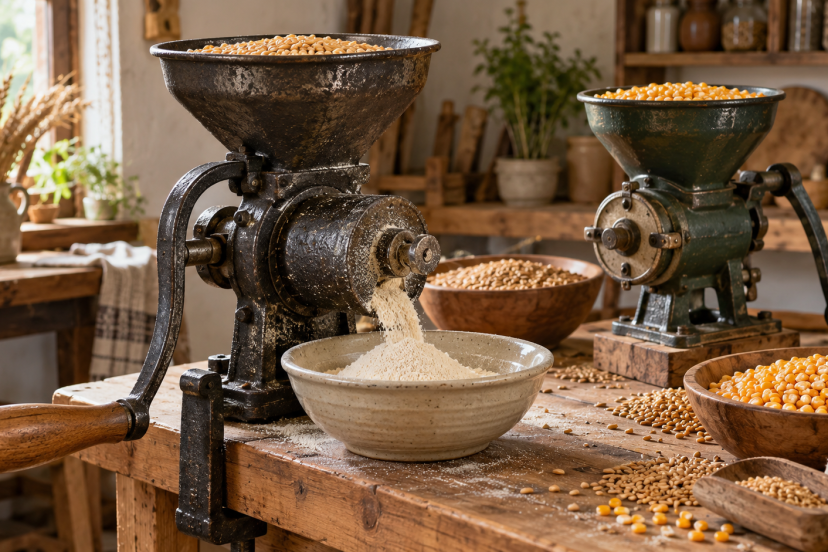
Freshly milled flour can completely change the way you approach homemade bread, pancakes, pasta, and whole-grain baking. Instead of depending entirely on bags of pre-ground flour, grain mills let you turn wheat berries, rice, corn, oats, and other compatible grains into flour when you actually need it.
The challenge is choosing the right type. Some mills prioritize speed, others give you precise control over texture, while manual models make more sense for homesteading and emergency preparedness. This guide compares ten worthwhile choices for different kitchens, budgets, and milling habits.
Our Top Picks
| Product | Best For | Key Feature | Rating |
| NutriMill Classic Grain Mill | Best overall | High-speed impact milling | ★★★★★ |
| NutriMill Harvest Grain Mill | Stone-ground flour | Corundum milling stones | ★★★★★ |
| WonderMill Electric Grain Mill | Large batches | Powerful 1,250W motor | ★★★★⯪ |
| VEVOR 3000W Electric Grain Mill Grinder | High-volume grain grinding | 3000W motor with adjustable grind | ★★★★★ |
| KitchenAid KGM Grain Mill | KitchenAid owners | Mixer-powered metal mill | ★★★★⯪ |
| Victoria High Hopper Grain Grinder | Budget manual milling | Heavy cast-iron construction | ★★★★⯪ |
| Moongiantgo 150g Grain Grinder | Small fine-grinding jobs | 28,000 RPM motor | ★★★★⯪ |
| Goldtouch 150g Grain Grinder | Grains and spices | Compact stainless-steel chamber | ★★★★⯪ |
| 750g High-Speed Electric Grain Mill Grinder | Fast home grain and spice grinding | 750g stainless-steel grinding chamber with high-speed motor | ★★★★⯪ |
| Mountain Essentials Hand Grain Mill | Off-grid use | Heavy-duty manual design | ★★★★⯪ |
Top 10 Grain Mills Reviewed
1. NutriMill Classic High-Speed Grain Mill

The NutriMill Classic is an easy choice for households that regularly turn wheat berries and other dry grains into flour. Its 1,200-watt motor and impact-style milling system emphasize speed, making it better suited to frequent bread baking than a small spice-style grinder.
The mill can produce fine flour while handling substantial batches, so you do not have to refill a tiny grinding cup repeatedly. Its enclosed flour collection system also helps control the mess associated with high-speed milling.
Key features: 1,200-watt motor, impact milling system, adjustable flour texture, large flour capacity
Best for: Families regularly baking bread with freshly milled flour
Pros: Fast operation; high capacity; strong customer feedback; established brand
Cons: Louder than many stone mills; not designed for oily ingredients
Why we recommend it: It combines useful capacity with the speed most frequent home bakers want. Current product data shows particularly strong customer feedback for the Classic.
2. NutriMill Harvest Grain Mill

If you specifically want a traditional stone-milling approach, the NutriMill Harvest deserves a closer look. It uses durable corundum milling stones and a 450-watt motor, allowing you to adjust the texture from fine flour toward coarser meal.
Its bamboo housing also looks more at home on a kitchen counter than many appliance-style flour mills. Because it weighs around 16 pounds, it feels substantial without becoming particularly cumbersome.
Key features: 450-watt motor, corundum stones, adjustable texture control, bamboo housing
Best for: Bakers who prefer stone-ground flour
Pros: Excellent texture control; attractive design; compact footprint; thermal protection
Cons: More expensive than entry-level impact mills; slower than high-speed models
Why we recommend it: It strikes an appealing balance between traditional stone milling and convenient everyday electric operation. NutriMill specifies a five-year warranty and thermal shutoff protection.
3. WonderMill Electric Grain Mill

The WonderMill Electric Grain Mill is built around speed and volume. Its 1,250-watt motor can process wheat, rice, corn, beans, and many other non-oily dry ingredients, making it particularly useful for households that prepare several loaves at once.
An enclosed collection system directs flour away from the milling chamber, which is considerably more convenient than catching flour directly below an open grinder.
Key features: 1,250-watt motor, stainless-steel milling chamber, flour canister, high-capacity operation
Best for: Large batches of bread flour
Pros: Fast; handles many dry grains; generous capacity; proven design
Cons: Takes more storage space; produces the noise expected from a high-speed mill
Why we recommend it: It makes more sense than a small grinder when flour production is part of your weekly routine. Available customer data shows strong feedback across hundreds of owners.
4. VEVOR 3000W Electric Grain Mill Grinder

The VEVOR 3000W Electric Grain Mill Grinder is a heavy-duty choice for users who need to process larger batches of grain quickly. Its powerful motor and stainless-steel hopper suit wheat, corn, soybeans, spices, and other dry ingredients.
The adjustable grinding system also gives you more control over texture, making it useful for both coarse meal and finer flour.
Key features: 3000W motor, adjustable grind, stainless-steel hopper, high-capacity design
Best for: High-volume grain grinding
Pros: Powerful; fast; adjustable; durable construction
Cons: Heavy; requires more storage space
Why we recommend it: It offers much more grinding capacity than a standard household mill while still giving you useful control over the finished texture.
5. KitchenAid KGM All Metal Grain Mill Attachment

Already own a KitchenAid stand mixer? The KGM Grain Mill Attachment lets you add milling capability without finding counter space for another motorized appliance.
Its adjustable mechanism handles dry, low-moisture grains such as wheat, corn, rice, oats, barley, buckwheat, and millet. The grind can be adjusted through multiple settings ranging from coarse cracked grain toward finer flour.
Key features: All-metal body, multiple grind settings, stand-mixer powered, cleaning brush included
Best for: KitchenAid stand-mixer owners
Pros: Saves counter space; no additional motor; sturdy construction; adjustable grind
Cons: Requires a compatible mixer; slower than dedicated high-speed mills
Why we recommend it: It is a practical way to experiment with home milling when you already have the power source sitting on your counter.
6. Victoria Manual High Hopper Grain Grinder

The Victoria High Hopper Grain Grinder is a completely different machine from an electric flour mill. Its cast-iron construction, hand crank, and table clamp make it particularly useful for cracking corn, processing coarse grains, and working without electricity.
It has thousands of customer ratings and can handle considerably more than wheat alone. However, shoppers expecting silky bread flour should understand that this style of grinder generally produces a coarser result than a dedicated stone or impact flour mill.
Key features: Cast-iron construction, hand crank, adjustable grind, table clamp
Best for: Corn, coarse grain and occasional off-grid use
Pros: No electricity required; affordable; durable; large review history
Cons: Requires physical effort; not ideal for ultra-fine bread flour
Why we recommend it: It offers straightforward mechanical reliability when versatility and independence from electricity matter more than speed.
7. Moongiantgo 150g Electric Grain Grinder

The Moongiantgo 150g takes the pulverizer approach. Its 850-watt motor drives stainless-steel blades at up to 28,000 RPM, allowing small batches of dried grains, herbs, coffee, and spices to become extremely fine.
Its 150-gram chamber is far smaller than a dedicated flour mill, but that can actually be an advantage when you only need a cup or two for a recipe.
Key features: 850-watt motor, 150g chamber, stainless-steel construction, high-speed blades
Best for: Small batches and superfine grinding
Pros: Compact; fast; affordable entry point; versatile
Cons: Small capacity; noticeably noisy; requires short operating cycles
Why we recommend it: It gives occasional users a relatively inexpensive route into fresh milling without dedicating significant counter space to the job. Customer data shows strong feedback from hundreds of buyers.
8. Goldtouch 150g Electric Grain Grinder
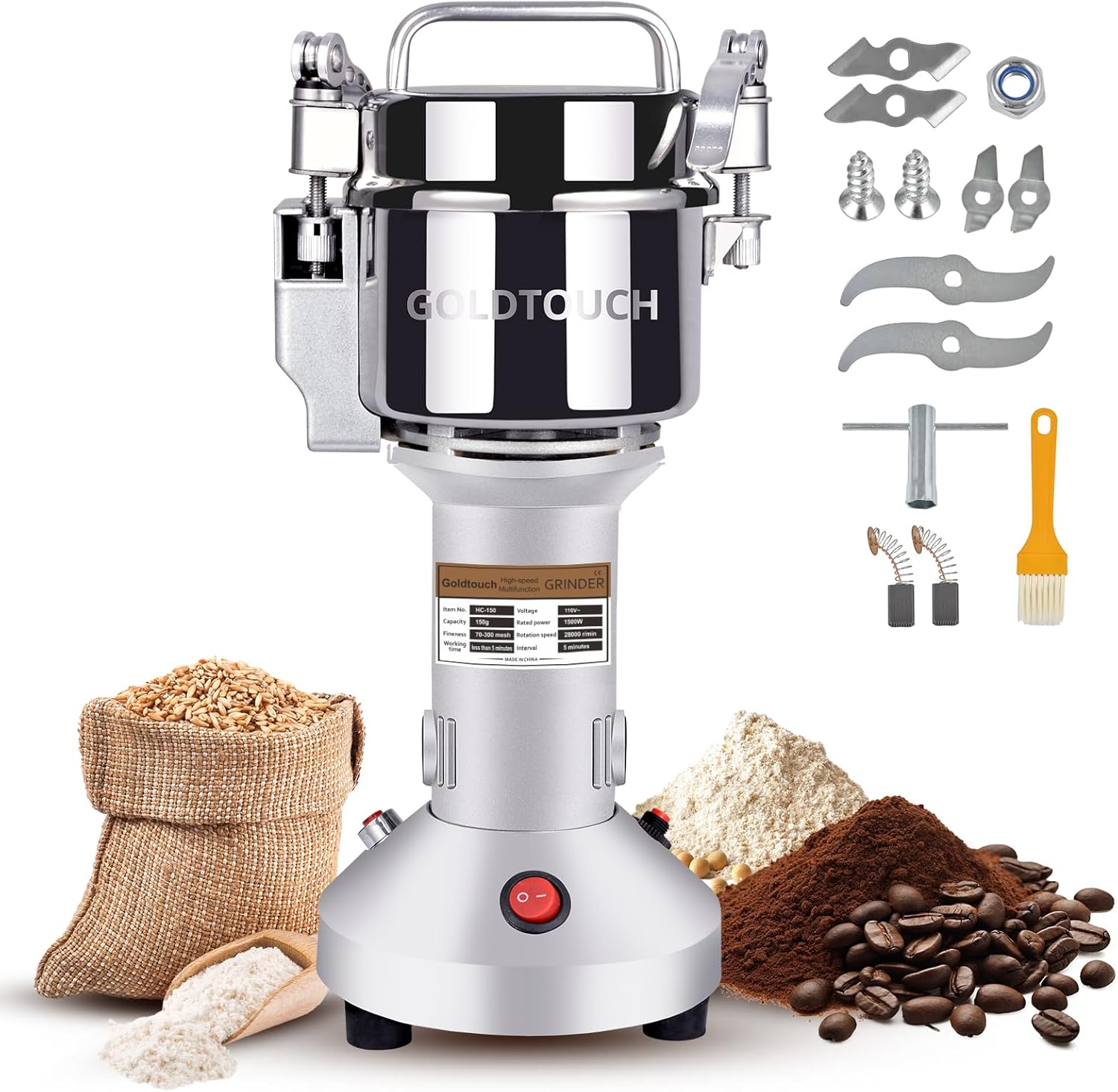
The Goldtouch 150g Grain Grinder is another compact pulverizer aimed at users who need fine powder rather than large volumes of bread flour.
Its stainless-steel chamber and powerful high-speed motor work particularly well for dry grains and spices. Because the capacity is limited, it is better for specialty recipes than for milling several pounds of wheat in one session.
Key features: 150g capacity, 1,500-watt motor, stainless-steel chamber, high-speed grinding
Best for: Small batches of grain, spices and dried ingredients
Pros: Powerful for its size; compact; quick processing; fine output
Cons: Limited batch size; not a continuous-duty flour mill
Why we recommend it: It makes sense for shoppers who value versatility and fine grinding more than bulk production. Available marketplace data shows strong customer ratings for this model.
9. 750g High-Speed Electric Grain Mill Grinder

This 750g electric grain mill uses a high-speed motor and stainless-steel grinding chamber to turn dry grains, spices, herbs, coffee, rice, and corn into fine powder. It is designed for users who want faster processing without hand cranking.
Its enclosed pulverizing design makes it better suited to dry ingredients than oily or wet foods.
Key features: 750g capacity, high-speed electric motor, stainless-steel grinding chamber, multipurpose dry grinding
Best for: Fast home grain and spice grinding
Pros: Powerful; large capacity; versatile; no manual cranking
Cons: Requires electricity; unsuitable for wet or oily ingredients
Why we recommend it: It offers much faster grinding than a manual mill while handling a wide variety of dry grains and pantry ingredients.
10. Mountain Essentials Manual Hand Grain Mill

The Mountain Essentials Manual Grain Mill is aimed squarely at buyers who want a substantial hand-powered option for preparedness, camping, or an electricity-independent kitchen.
Its stainless-steel construction is more refined than bargain cast-iron grinders, although fine flour may require more than one pass with harder wheat varieties.
Key features: Manual operation, stainless-steel construction, adjustable grinding, heavy-duty build
Best for: Emergency preparedness and off-grid milling
Pros: No electricity; robust construction; portable power independence; adjustable output
Cons: Considerable hand effort; slower than electric mills
Why we recommend it: It suits buyers who prioritize durability and independence over maximum convenience.
How to Choose the Best Grain Mill
Start with what you actually plan to make.
For frequent bread baking, an electric impact or stone mill usually makes the most sense. Impact mills are fast and excellent for producing flour in quantity, while stone mills give you more control over texture and are appealing to bakers who regularly experiment with whole-grain flour.
A manual mill makes more sense when electricity independence, simplicity, or emergency preparedness matters. Just remember that grinding several cups of hard wheat by hand takes considerably more effort than turning on an electric machine.
Capacity matters too. A 150-gram pulverizer works beautifully for occasional specialty flour or spices, but it quickly becomes tedious if you need enough flour for several loaves.
Finally, check the manufacturer’s approved ingredients. Grain mills are not automatically suitable for oily nuts, moist foods, coffee, or every type of seed. Putting unsupported ingredients through the machine can clog the mechanism or damage the milling surfaces.
A grain mill also fits naturally alongside other basic homesteading skills, especially scratch cooking, bread making, and long-term food storage.
Final Thoughts
The best grain mills depend less on flashy specifications than on how often and how much you intend to mill. The NutriMill Classic and WonderMill make sense for high-volume flour production, while the NutriMill Harvest and Mockmill 100 offer greater appeal for bakers who prefer stone milling and adjustable textures. KitchenAid owners can keep things compact with the KGM attachment, while Victoria, Roots & Branches, and Mountain Essentials provide useful manual alternatives. Choose around your typical batch size, preferred flour texture, available space, and whether working without electricity matters to you.
FAQs
What is the best grain mill for home use?
For regular bread baking, a dedicated electric grain mill such as the NutriMill Classic, WonderMill, NutriMill Harvest, or Mockmill 100 is generally the most convenient. The best choice depends on whether you prefer faster impact milling or adjustable stone grinding.
Is a stone grain mill better than an impact mill?
Neither design is automatically better. Stone mills provide excellent texture control from fine flour to coarser meal, while impact mills typically process larger quantities quickly. Your baking habits should determine which design is more useful.
Can a grain mill grind corn?
Many grain mills can grind dry corn, but you should check the manufacturer’s instructions for the specific model. Manual cast-iron grinders are particularly popular for cornmeal, while several electric mills can also process properly dried corn.
Can you grind wheat berries into flour at home?
Yes. Wheat berries are among the most common ingredients processed with home grain mills. Dedicated flour mills can turn hard or soft wheat into freshly milled whole-wheat flour for bread, pancakes, muffins, pasta, and other recipes.
Are manual grain mills worth buying?
Manual grain mills can be worthwhile for emergency preparedness, off-grid homes, occasional use, and anyone who wants a mill without an electric motor. They are slower and require more effort, however, so frequent bakers often prefer an electric model.