Top 10 Long Term Solar Power Kit
We may earn a commission for purchases made using our links. Please see our disclosure to learn more.
When the grid goes down for more than a few hours, a small battery pack stops being very useful. A long term solar power kit combines meaningful battery capacity with solar charging so you can keep refrigerators, lights, communication devices, CPAP machines, tools, and other essentials running without relying entirely on fuel.
For this guide, we focused on systems with long-life LiFePO4 batteries, useful solar input, reputable manufacturers, strong owner feedback, and enough output for real-world backup power. Some are portable enough for camping or an RV, while others are better suited to serious home preparedness.
Our Top Picks
| Product | Best For | Key Feature | Rating |
| Jackery HomePower 3600 Plus | Extended home backup | 3,584Wh expandable capacity | ★★★★★ |
| BLUETTI Elite 200 V2 | Battery longevity | 6,000+ LFP cycles | ★★★★★ |
| Jackery HomePower 3000 | Household essentials | 3,072Wh / 3,600W output | ★★★★⯪ |
| Jackery Solar Generator 2000 v2 | Portable 2kWh backup | Lightweight 2,042Wh design | ★★★★★ |
| BLUETTI AC200L | Expandability | Up to 8,192Wh capacity | ★★★★★ |
| EcoFlow DELTA 2 Max | Fast solar recovery | Up to 800W solar input | ★★★★⯪ |
| Jackery Solar Generator 1000 v2 | Compact backup | 1,070Wh at just 23.8 lb | ★★★★★ |
| BLUETTI AC180 | Value | 1,152Wh and 1,800W output | ★★★★★ |
| Anker SOLIX C1000 | Camping and outages | Compact 1kWh LFP system | ★★★★⯪ |
| Renogy 400W 12V Premium Solar Kit | Off-grid solar installations | Four 100W monocrystalline panels | ★★★★☆ |
Top 10 Long Term Solar Power Kit Options
1. Jackery HomePower 3600 Plus Solar Generator

The HomePower 3600 Plus is built for buyers who want significantly more than occasional camping power. Its 3,584Wh LFP battery delivers 3,600W of continuous AC output and can be expanded dramatically with additional batteries.
Jackery rates the battery for thousands of cycles, while current models support up to 1,000W of solar input. Wheels and a telescoping handle also make the roughly 77-pound station easier to reposition than its size suggests. Current Amazon-facing data shows strong customer ratings, while the system is expandable to roughly 21kWh per unit.
Key features: 3,584Wh LFP battery; 3,600W output; expandable capacity; high solar input; UPS capability
Best for: Serious home backup and long outages
Pros: Huge expansion potential; powerful AC output; long-cycle battery; wheeled design
Cons: Expensive; heavy; overkill for basic camping
Why we recommend it: It offers one of the strongest paths from portable backup to a genuinely substantial home energy reserve.
2. BLUETTI Elite 200 V2 Solar Generator Kit

The Elite 200 V2 pairs approximately 2,074Wh of battery capacity with 2,600W AC output. Bundles are available with portable solar panels, including configurations using two 200W panels.
Its biggest attraction is longevity. Current product information specifies more than 6,000 battery cycles, making this an appealing choice for people who expect frequent use rather than occasional emergency charging. Recent Amazon-derived product data shows strong buyer feedback for the kit.
Key features: 2,073.6Wh; 2,600W output; 6,000+ cycles; fast charging
Best for: Frequent long-term use
Pros: Exceptional cycle life; strong appliance output; compact for its capacity
Cons: Heavy; less expandable than some BLUETTI models
Why we recommend it: Its unusually high cycle rating makes it particularly attractive when durability matters more than maximum expandability.
3. Jackery HomePower 3000 With Solar Panels
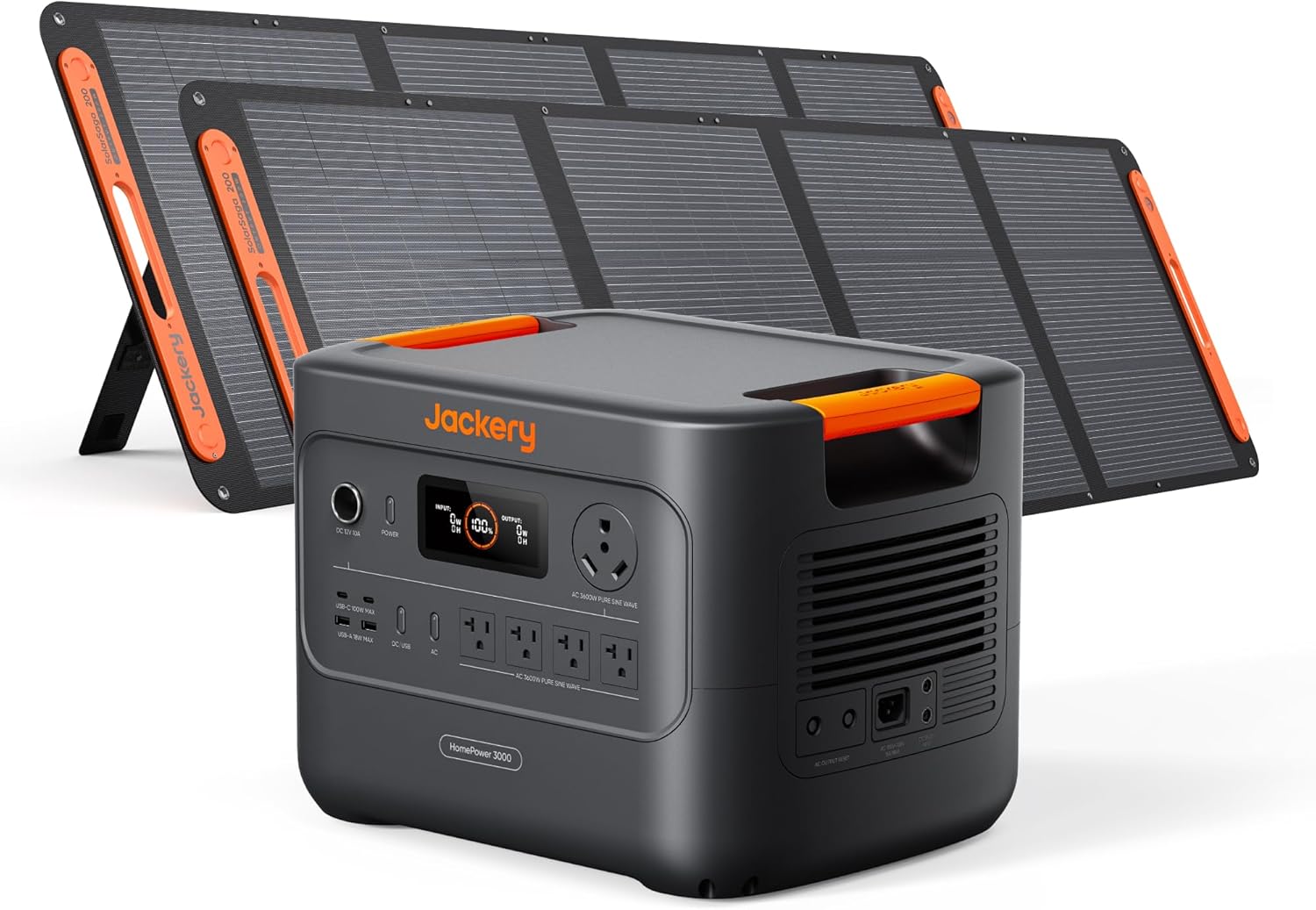
With 3,072Wh of capacity and 3,600W output, the HomePower 3000 sits in a practical middle ground between portable power stations and large home-backup systems.
The kit is available with two 200W panels, and its TT-30 RV connection adds flexibility for campers. Current Amazon product data shows a 4.5-star rating and hundreds of ratings for this configuration.
Key features: 3,072Wh; 3,600W output; 400W solar bundle; RV outlet
Best for: Home outages and RV owners
Pros: High capacity; powerful inverter; good port selection
Cons: Nearly 60 pounds; premium price
Why we recommend it: It provides enough stored energy to make a meaningful difference during an overnight or multi-day outage.
4. Jackery Solar Generator 2000 v2

The Explorer 2000 v2 delivers 2,042Wh in a surprisingly manageable package weighing around 39.5 pounds. The 2,200W output handles refrigerators, microwaves, coffee makers, computers, and many other household loads.
The popular bundle includes two 200W SolarSaga panels. Amazon-linked product data reports strong customer feedback for this version.
Key features: 2,042Wh; 2,200W output; 400W solar bundle; LFP battery
Best for: Portable high-capacity backup
Pros: Lightweight for 2kWh; fast AC charging; useful output
Cons: Less expandable than modular systems
Why we recommend it: Few 2kWh systems balance portability, capacity, and straightforward operation this well.
5. BLUETTI AC200L Solar Generator Kit

The AC200L is particularly appealing if your future power needs may grow. It starts with 2,048Wh and 2,400W AC output, but compatible expansion batteries can increase total storage dramatically.
It also supports up to 1,200W solar input, meaning a larger solar array can recharge it considerably faster than the small panel included in entry-level bundles.
Key features: 2,048Wh; 2,400W output; expandable battery; 1,200W solar input
Best for: Expandable off-grid systems
Pros: Excellent expansion options; strong solar input; RV connection
Cons: Larger panels are needed to exploit its charging potential
Why we recommend it: You can start relatively small without locking yourself into the original battery capacity.
6. EcoFlow DELTA 2 Max With 400W Solar Panel

EcoFlow’s DELTA 2 Max provides 2,048Wh of LFP storage and is particularly strong when fast recharging matters. It supports substantial solar input and can also combine solar and AC charging.
The 400W panel bundle is better suited to long-term use than kits paired with tiny 100W panels because you have a much better chance of replacing meaningful daily consumption during good weather.
Key features: 2,048Wh; LFP battery; 400W panel; expandable storage
Best for: Fast daily solar replenishment
Pros: Fast charging; useful solar capacity; expandable
Cons: 400W portable panel is bulky
Why we recommend it: Strong charging performance makes it easier to keep the battery useful through consecutive off-grid days.
7. Jackery Solar Generator 1000 v2
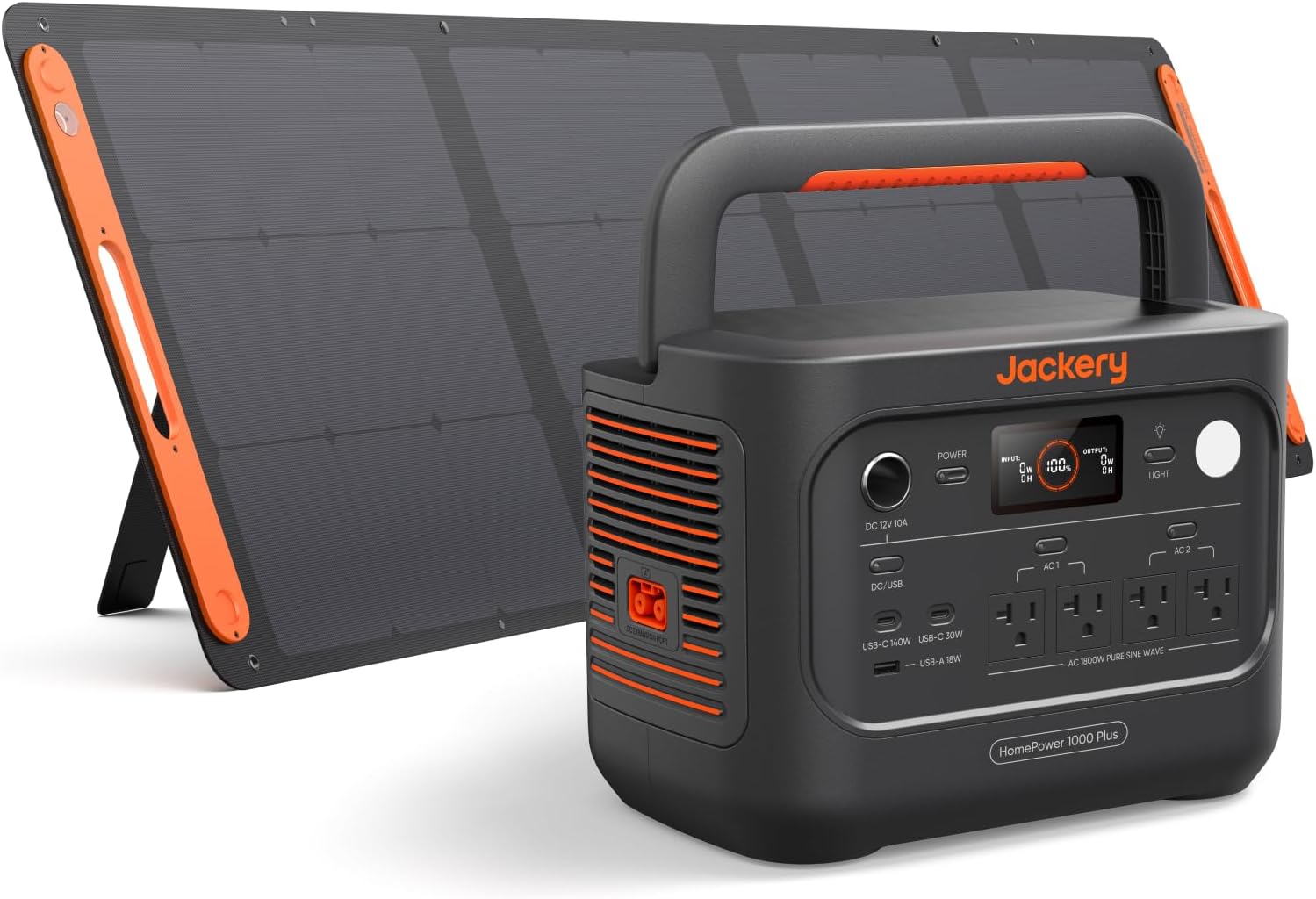
Not everyone needs 2–3kWh. The Jackery 1000 v2 gives you 1,070Wh, 1,500W AC output, and a portable 200W solar panel while keeping the power station itself under 24 pounds.
Amazon product data shows more than 1,400 ratings and strong overall feedback, making this one of the better-established smaller systems.
Key features: 1,070Wh; 1,500W output; 200W panel; 23.8-pound station
Best for: Camping and basic emergency backup
Pros: Portable; established product; fast charging
Cons: Limited capacity for multi-day appliance use
Why we recommend it: It is easier to carry and store than the 2kWh models without dropping into underpowered “phone charger” territory.
8. BLUETTI AC180 With 200W Solar Panel

The AC180 provides 1,152Wh and 1,800W AC output, making it capable of powering considerably more than electronics. Four AC outlets and multiple USB connections give it useful flexibility around camp or during outages.
Its 200W solar kit is manageable for occasional travel, although serious daily off-grid users may eventually want more panel capacity.
Key features: 1,152Wh; 1,800W output; 200W solar panel; UPS mode
Best for: Value-conscious buyers
Pros: Strong inverter for its size; versatile ports; LFP battery
Cons: Included panel is modest for daily heavy consumption
Why we recommend it: It hits a useful balance between price, appliance capability, and portability.
9. Anker SOLIX C1000 Solar Generator

The SOLIX C1000 is another compact LFP option aimed at backup power, RVs, and camping. Current bundles pair roughly 1kWh of battery storage with a 200W solar panel and enough inverter power for refrigerators and many kitchen appliances.
Anker also backs the platform with long-life battery technology and a multi-year warranty. Current Amazon-linked availability was confirmed in September 2026.
Key features: About 1,024Wh; up to 2,000W output on current generation; 200W panel
Best for: Compact household backup
Pros: Small footprint; strong output; reputable brand
Cons: 1kWh drains quickly under continuous high loads
Why we recommend it: It offers unusually capable AC output without forcing you to store a huge power station.
10. Renogy 400W 12V Premium Solar Kit

The Renogy 400W Premium Solar Kit is a more traditional choice for buyers building a permanent or semi-permanent off-grid power setup. It includes four 100W monocrystalline solar panels and a Rover 40A MPPT charge controller, making it suitable for RVs, cabins, boats, tiny homes, and other long-term installations.
Unlike a portable power station bundle, this system is designed to connect to a separate battery bank. The MPPT controller supports 12V and 24V systems, while the included Bluetooth module makes it easier to monitor system performance. The package also includes mounting brackets, wiring, connectors, and essential fuse protection.
Key features: 400W total solar capacity; four 100W monocrystalline panels; 40A MPPT controller; Bluetooth monitoring
Best for: Permanent RV, cabin, boat, or off-grid solar installations
Pros: Complete installation hardware; efficient MPPT controller; expandable system; Bluetooth monitoring
Cons: Battery and inverter must be purchased separately
Why we recommend it: It provides the core components needed for a capable long-term solar array while giving buyers flexibility to choose their own battery capacity and inverter.
How Much Capacity Do You Actually Need?
Start by adding the watt-hours used by the devices you consider essential. A refrigerator cycling throughout the day, Wi-Fi router, lights, phones, laptop, and CPAP can consume far more energy than their individual wattages suggest.
For light backup, around 1,000Wh can work well. For refrigerators and longer outages, 2,000–3,500Wh provides considerably more breathing room. Full-time off-grid homes generally require a larger expandable battery bank rather than a single portable power station.
If your goal is broader household independence, these self-sufficient backyard ideas also cover solar lighting and other low-energy systems that can reduce dependence on grid electricity.
Final Thoughts
The right long term solar power kit depends less on finding the biggest battery and more on matching battery capacity, solar input, output power, portability, and expandability to how you actually plan to use it. The Jackery HomePower 3600 Plus and HomePower 3000 make sense for heavier household backup, while the BLUETTI AC200L and EcoFlow DELTA 2 Max provide flexible expansion and strong solar charging. For camping or lighter outage preparation, the Jackery 1000 v2, BLUETTI AC180, and Anker SOLIX C1000 offer a more manageable balance of size and capability. Whatever you choose, prioritize LFP battery chemistry and enough solar wattage to replenish the energy you expect to consume.
FAQs
How long can a solar power kit provide electricity?
Runtime depends on battery capacity and the wattage of connected devices. A 2,000Wh battery may run a 100W average load for roughly 15–18 hours after allowing for inverter losses, while high-powered appliances will drain it much faster.
Is LiFePO4 better for long-term solar power?
For most portable backup systems, yes. LiFePO4 batteries typically provide thousands of charging cycles, good thermal stability, and considerably longer service life than many older lithium-ion chemistries.
How many watts of solar panels do I need?
A 100–200W panel is adequate for light use, but 400–800W is much more practical for replenishing a 1–2kWh battery during regular off-grid use. Actual output depends on sunlight, temperature, shading, panel angle, and weather.
Can a solar generator run a refrigerator overnight?
Yes, many 1,000Wh and larger systems can run an efficient refrigerator overnight. Runtime varies because refrigerator compressors cycle on and off rather than drawing their rated wattage continuously.
Can I leave a solar power station plugged in for backup?
Many modern models include UPS or pass-through functionality designed for backup use. Check the manufacturer’s instructions for the specific model, since supported operating modes and battery-management settings differ.